Microstructure
& Connectivity Lab

Vanderbilt University Medical Center

Microstructure
& Connectivity
Lab

We develop and test MRI methods for measuring tissue organization and tracing white matter pathways in the brain and spinal cord.

Loading pathways…

Explore the pathwaysChange colors, compare centroids, and rotate the glass brain.
Open full explorer

Nature · 2026-05-13

White matter micro- and macrostructure brain charts for the human lifespan

White matter growth charts built from 35,120 brain scans provide reference trajectories from birth to 100 years. The study measures tissue properties and pathway shape across 72 tracts, enabling age- and sex-adjusted comparisons. Public models, processing tools, and shareable derived data support independent use of the charts.

Read the study and access the resources →
Lifespan trajectories of white matter microstructure across major brain pathways.
Kim et al. (2026), Figure 2. Lifespan trajectories of white matter microstructure across major brain pathways. CC BY 4.0. Age axes are logarithmic; cyan denotes males and red denotes females.

Research

Measuring white matter.

What can an MRI measurement tell us about tissue? Which pathways can tractography recover reliably? How does white matter change across the lifespan? These questions guide our work in acquisition, modeling, and validation.

Research areas →

Publications

Recent papers

All publications →
Standard model imaging parameter maps in the brain and spinal cord of a person with relapsing-remitting MS.
NMR in Biomedicine · 2026Article

Standard Model Imaging in the Brain and Spinal Cord of MS Patients: Initial Assessment and Comparison to Diffusion Tensor Imaging

Same-session brain and spinal cord imaging compares standard diffusion tensor measurements with Standard Model Imaging in 34 people with relapsing-remitting multiple sclerosis and 36 controls. Neurite density estimates show sensitivity to pathology in both regions, while the usefulness of other measurements depends on the anatomical setting.

Summary & resources →
Examples of age-dependent white matter asymmetry across microstructural and macrostructural features.
Human Brain Mapping · 2026Article

Lifespan Trajectories of Asymmetry in White Matter Tracts

White matter asymmetry changes with age and depends on which tissue or pathway feature is measured. Using 35,120 individuals from 50 studies, this work charts 30 paired pathways from birth to 100 years. It provides a reference for interpreting lateralization across development and aging.

Summary & resources →
High-resolution diffusion images and tractography from the four-direction phase-encoding acquisition.
Magnetic Resonance Imaging · 2026Article

Advancing high-resolution 7 T diffusion MRI: Evaluating phase-encoding correction strategies for distortion correction from basic to four-way acquisitions

At 0.9 mm resolution on a NexGen 7T scanner, this study compares 11 time-matched diffusion acquisition and correction strategies. Four-direction phase encoding provides the strongest geometric fidelity and repeatability in five adults scanned twice. The findings inform high-resolution protocols for both fine superficial connections and long-range pathways.

Summary & resources →

Work in progress

Preprints

All preprints →
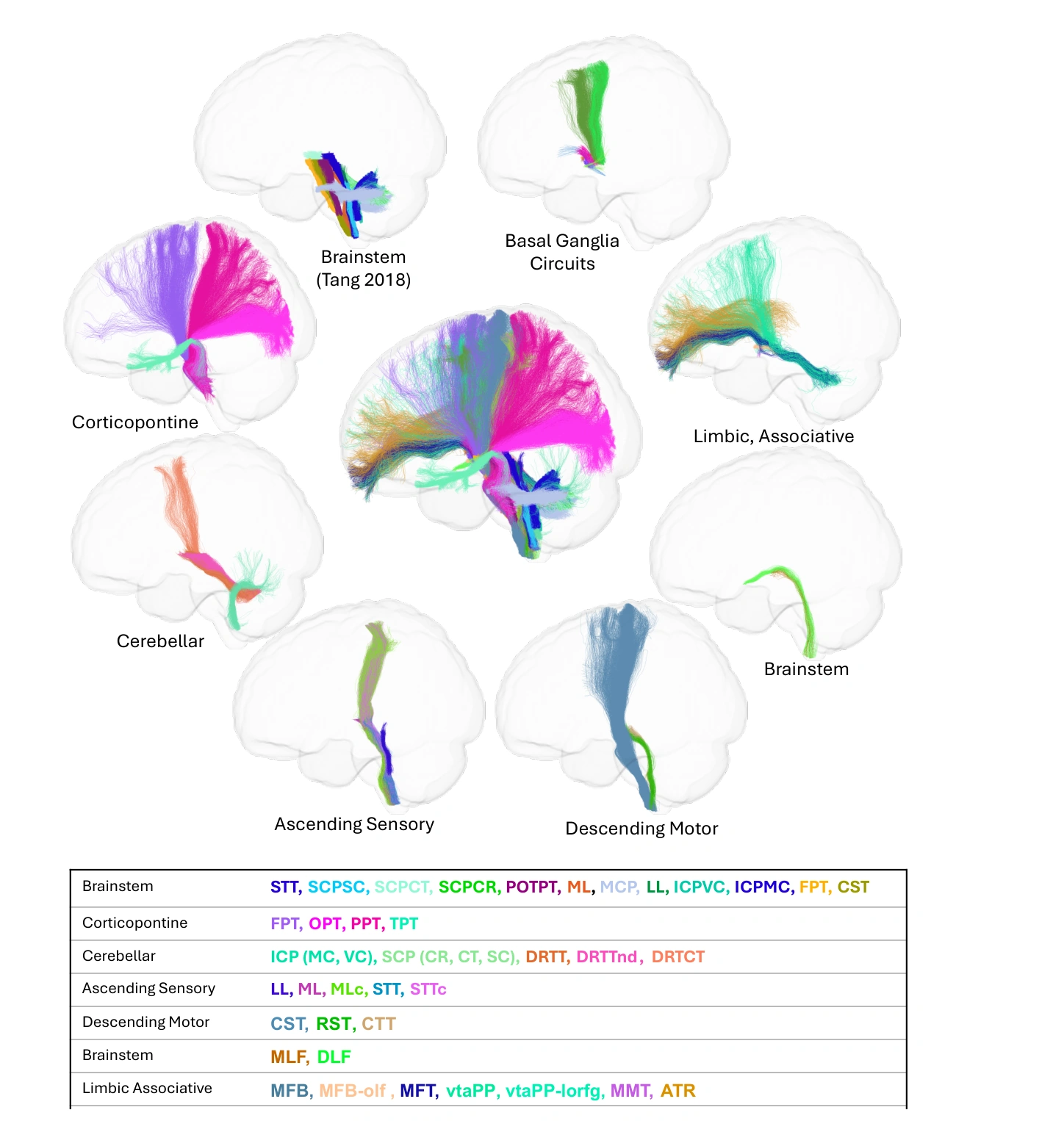
Representative brainstem and subcortical pathways used to construct the BundleParc reference labels.
bioRxiv · 2026Preprint · not peer reviewed

Automated Segmentation of Brainstem and Subcortical White Matter: Mapping the Deep Tegmental Core with BundleParc

This preprint extends BundleParc to segment and divide 97 brainstem and subcortical white matter pathways along their trajectories. Trained from anatomically curated Human Connectome Project tractography, the method operates on native-space fiber orientation distributions. External datasets test its performance across development, aging, disease cohorts, and acquisition differences.

Summary & resources →
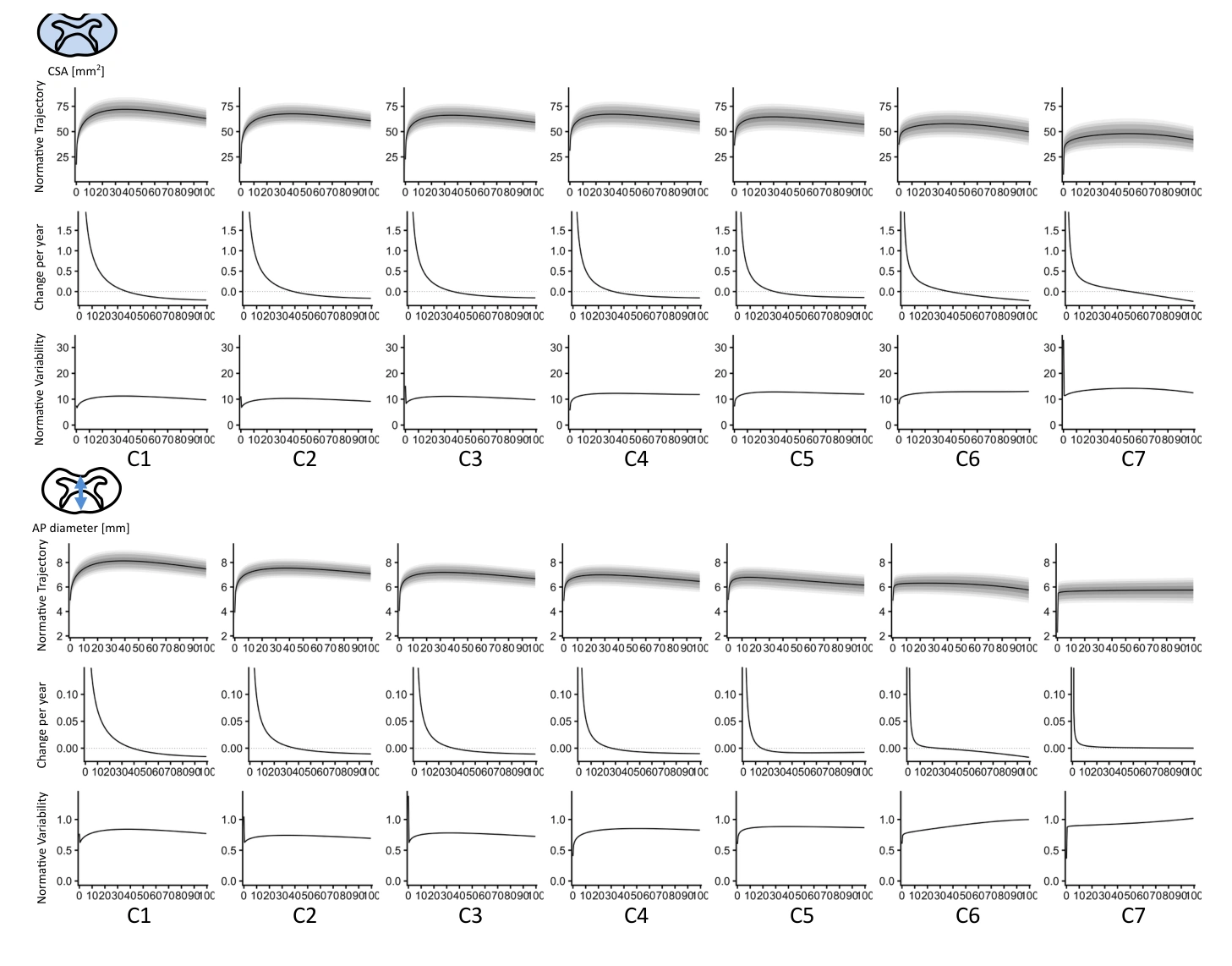
Lifespan trajectories, rates of change, and population variability in cervical spinal cord morphometry.
bioRxiv · 2026Preprint · not peer reviewed

Charting Cervical Spinal Cord Morphometry Across the Lifespan

This preprint develops cervical spinal cord reference charts using 78,269 scans from 41,042 individuals across 30 datasets. Measurements from C1 to C7 capture size and shape from birth to age 100. The charts reveal regional and sex differences and support age-adjusted comparison of individual cord measurements.

Summary & resources →
Software and data

All resources →

In the news

All news →

Tractography

White matter, up close.

Examine the arcuate, corticospinal, and callosal pathways. Compare their trajectories, isolate a bundle, or follow its central course.

Open the streamline viewer →
Arcuate, corticospinal, and callosal pathways rendered as illuminated tubes inside the matching brain